

Standing in the Garden Lobby of The Scottish Parliament last week, listening to speeches about a “Year of American Independence 250” while the Stars and Stripes hung alongside the Saltire, felt both timely and quietly radical. To be invited as a guest of the US Consulate was a reminder that, even in a turbulent political moment, the relationship between Scotland and the United States is deeper than any single election cycle.
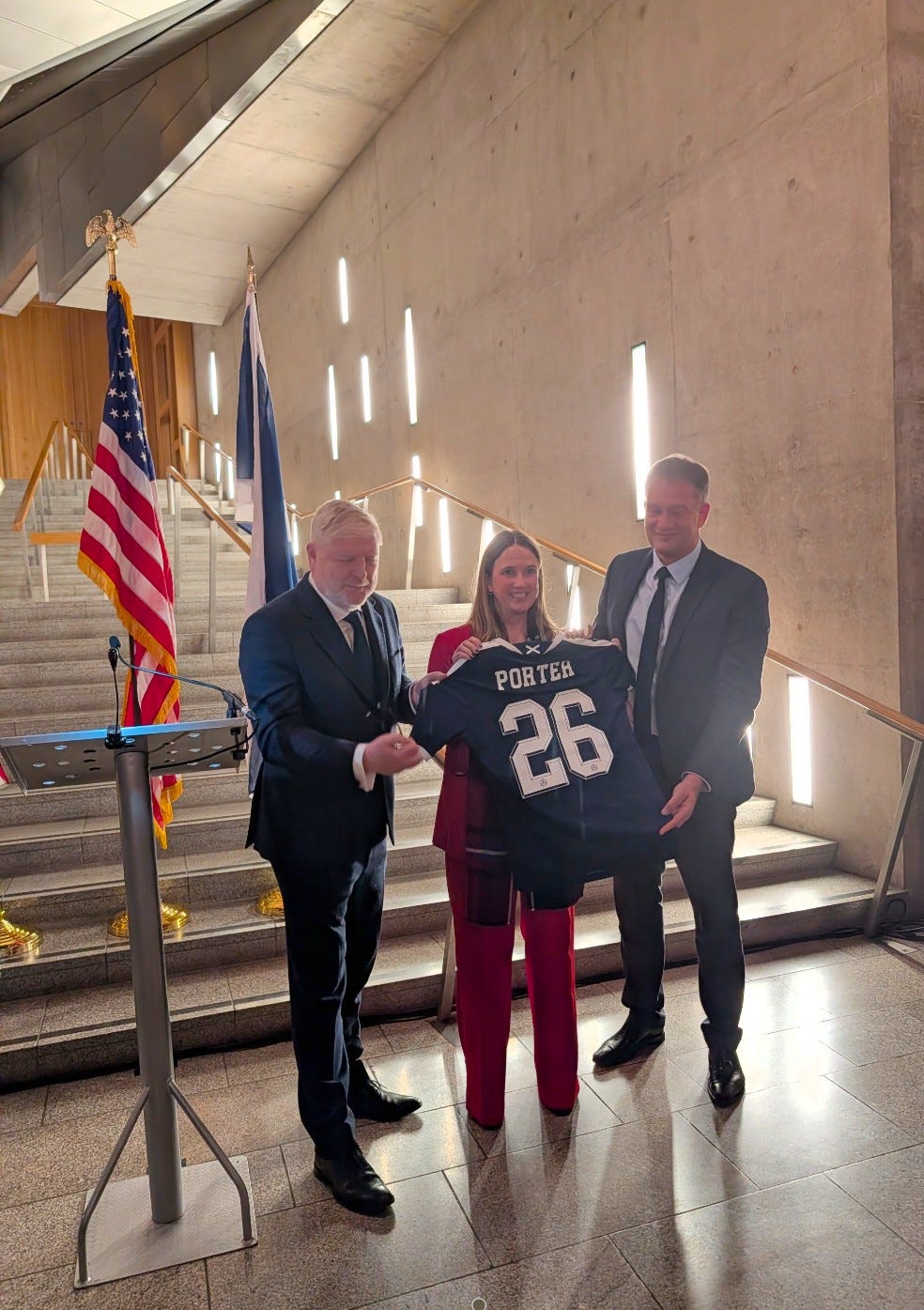
Ian Maxwell Chief Executive of SFA and Angus Robertson MSP present Kathryn Porter US Consul General with a Scotland football top
A year of anniversaries and questions
The event marked the launch of a year-long programme leading up to the 250th anniversary of American independence in 2026, a moment that inevitably invites questions about democracy, power and who gets to write the story of a nation. In the room were diplomats, parliamentarians, business leaders and cultural organisations, all trying in their own way to answer a shared question: how do Scotland and America continue to talk to one another honestly when the world feels so polarised?
The tone was hopeful rather than triumphalist. There was acknowledgement that this anniversary lands at a time of profound political strain in the US and across Europe, yet also a conviction that diplomatic, cultural and business links are exactly what help countries navigate those strains. Scotland’s story in America has never been simple hero worship; it has been negotiation, adaptation and, at times, principled disagreement carried across the Atlantic.
Ties that outlast politics
In the quiet conversations after the speeches, the talk turned less to Washington and more to the web of everyday connections – the universities that exchange students, the small firms trading across the Atlantic, the cultural projects that use arts and heritage to keep a conversation going. These are the relationships that continue regardless of which party holds office in Edinburgh, London or Washington, built over generations by people who believe that ideas and stories should travel freely.
What stood out was a shared understanding that “the relationship” is not an abstract thing managed only by embassies and consulates. It lives in diaspora family ties, in research collaborations, and in the way Scottish places like Dunfermline, Paisley or Aberdeen have quietly shaped American life for over two centuries. If anything, the current political climate only underlines the responsibility to protect and deepen those human-scale links.
Dunfermline’s imprint on America
For anyone from Dunfermline, Scotland, US connections start with Andrew Carnegie, the weaver’s son who left the town as a child, arrived in the United States with very little, and became one of the richest industrialists – and most prolific philanthropists – the world has ever seen. Carnegie’s money helped build more than 2,500 public libraries worldwide and endowed institutions from Carnegie Hall in New York to the Peace Palace in The Hague, yet he never stopped calling Dunfermline his “dear old home.”
Back in Dunfermline, his legacy is written into the fabric of everyday life: the humble Birthplace Museum, the gift of Pittencrieff Park “The Glen” to the people, the leisure centre and halls that grew from his determination that working people should have access to education, culture and fresh air. Carnegie’s story is, at heart, a transatlantic tale – Scottish in its origins, American in its scale and ambition, and global in its consequences.

Carnegie Birthplace Museum
A general, a road, and a new city
Carnegie is not the only Dunfermline-linked figure to reshape the American map. Brigadier General John Forbes, a Scottish officer who fought in the Seven Years’ War, led the 1758 expedition that seized the French fort of Duquesne and laid out a new British position at the forks of the Ohio River. Forbes chose to name the settlement “Pittsburgh,” establishing both the city and the strategic route known as Forbes Road that cut through Pennsylvania’s difficult terrain.
Less discussed, but just as important, is how Forbes approached alliance-building. Severely ill and carried in a litter for much of the campaign, he nevertheless devoted energy to diplomacy with Native American nations, helping shift the balance of power in the region and showing that military success could not be separated from political relationships on the ground. For a modern Scotland thinking about soft power and respectful partnership, his story feels uncomfortably contemporary.
The Scots who took golf to America
If Forbes and Carnegie represent steel, strategy and philanthropy, Dunfermline’s John Reid and Robert Lockhart bring a different kind of influence: leisure, identity and the small rituals that become global industries. Emigrating to the United States in the late nineteenth century, they missed their regular games of golf so much that they improvised a course in an orchard and then on a cow field, introducing American friends to a game that was still very much a Scottish export.
In 1888, Reid and Lockhart helped found The Saint Andrew’s Golf Club in New York, widely recognised as the first golf club in the USA, with Reid remembered as the “Grandfather of American Golf.” He even exported the tradition of the “19th hole,” persuading his companions that a round of golf was not complete without time set aside to talk it over with a drink – a tiny cultural detail that says a lot about how Scots carried not just skills but social customs across the Atlantic.
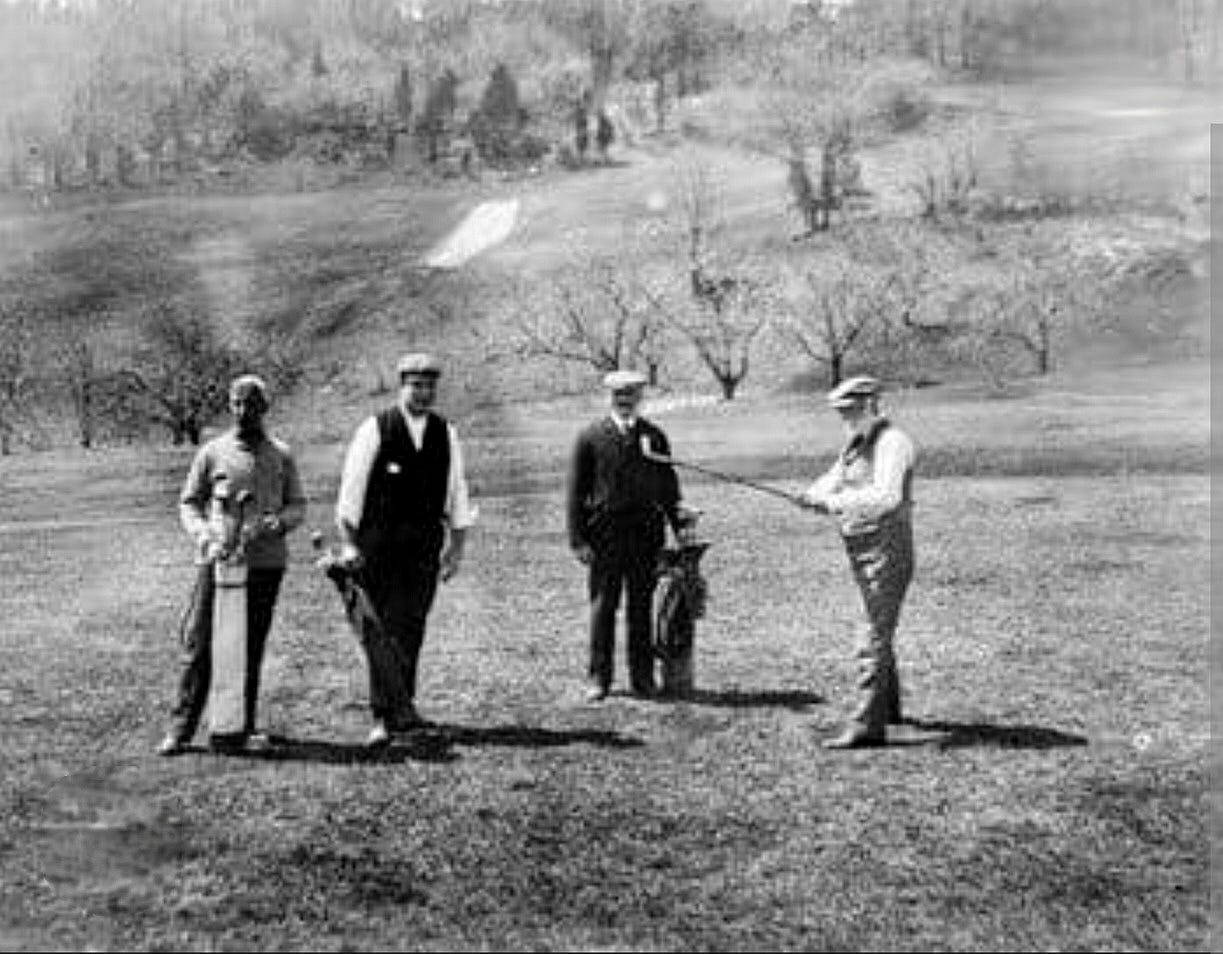
John Reid hosting Carnegie and others at Yonkers.
More than a shared past
What links Carnegie’s libraries, Forbes’ military road and Reid’s orchard golf is not nostalgia, but a pattern: people from Scottish towns and cities who went to America and altered its landscape, economy and culture, while staying tethered – emotionally and often financially – to the places they left behind. Their legacies remind Dunfermline that it is not a peripheral town gazing wistfully westward, but a place whose choices and characters have helped shape what the United States became.
At The Scottish Parliament, surrounded by politicians and business leaders speaking about trade, innovation and shared values, those older stories felt less like heritage branding and more like a challenge. If previous generations could carve out connections that survived wars, recessions and political upheavals, then there is every reason to believe that today’s Scotland and America can keep building relationships that are honest about disagreement yet committed to curiosity, cultural exchange and mutual benefit.
In a year when American democracy will be scrutinised from every angle and global politics will feel particularly fraught, a reception in Edinburgh might seem like a small thing. Yet in those conversations between parliamentarians and poets, entrepreneurs and educators, you could sense the quieter work of renewal: people choosing to show up, to listen, and to keep the transatlantic conversation going – not in spite of the political moment, but because of it.
Thanks for your continued support. Another big year lies ahead for our city.